
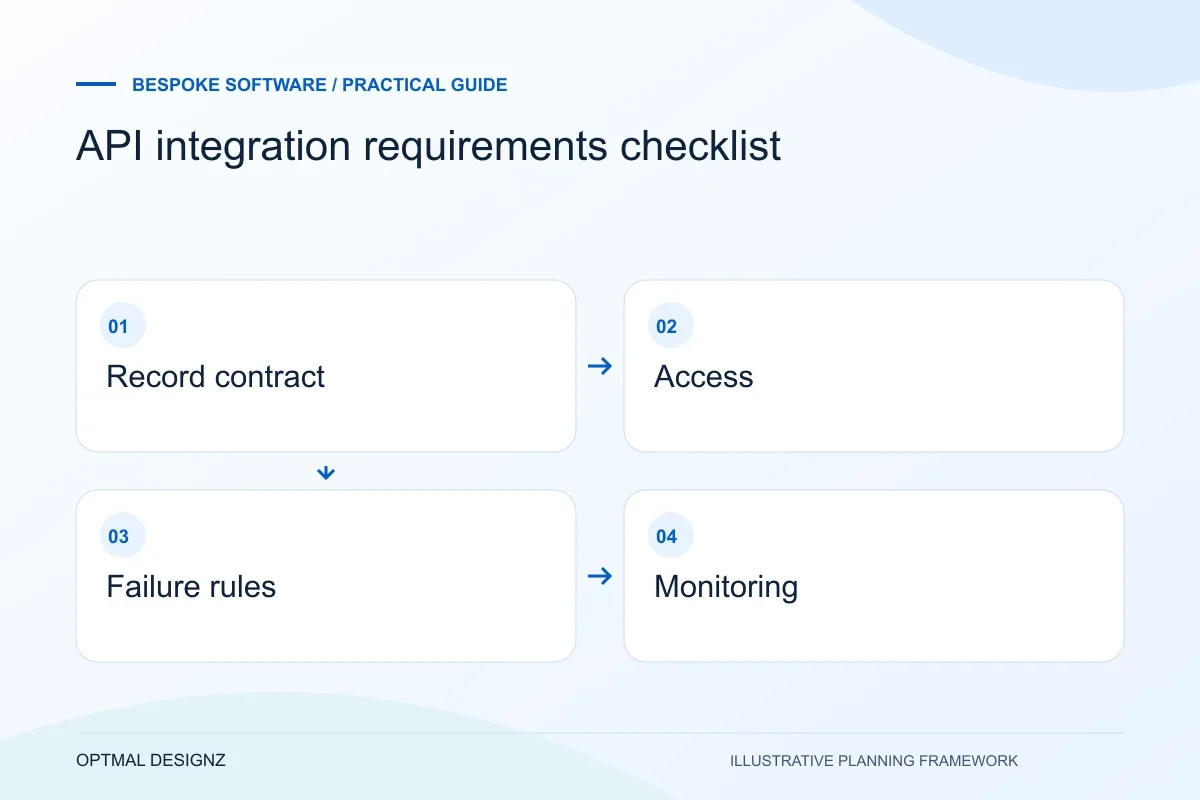
The decision this guide helps you make
An API integration contract describes the records, events, permissions and responses that two systems agree to exchange. It makes timing, validation, duplicate handling and failure recovery explicit before the connection is built.
Define records, identifiers, permissions, update behaviour, retries and monitoring before pricing an API connection between business systems.
Agree field definitions, authentication, rate limits, repeated-event behaviour and error ownership. Test both successful records and failures against that contract.
A practical example to test the choice
A timeout after an invoice request does not prove the invoice was never created. The contract needs an identifier and a safe way to determine the result before retrying.
This is an illustrative planning scenario, not a claim about a completed client project. Use your own records and operating rules to confirm whether the approach fits.
Describe the business event and expected result
An integration contract is more than an endpoint address. State what happens in the source system, which information must move and what should exist in the destination afterwards. An order-created event and a customer-address change can require different timing, ownership and correction rules.
List record identifiers, required fields, formats and validation decisions. Decide which values the receiving system may calculate or reject. Use representative examples, including a record that should not transfer, so the scope does not silently depend on every source record being complete.
Turn the Saudi operating model into a practical scope
Follow one task across the people and applications involved. A Riyadh sales office may pass an order to a Dammam warehouse; a service business may need customer approvals before billing. Define which record proves each step is complete and who may change it. Compare configuration and targeted integration before deciding a new application is necessary.
Document legal entities, locations, SAR and other currencies, language fields and role permissions. Review permitted personal-data handling and hosting arrangements with the responsible business owners. Use authorised sample records to test the process before moving to live information.
Specify what repetition and failure mean
A timeout does not always mean the destination performed no work. Ask how a repeated request is recognised and how the system avoids creating another order or payment record. Microsoft’s API guidance discusses idempotency and method behaviour; the developer should explain the actual protection used for the proposed operation.
Include unavailable services, revoked access, rejected values and events arriving out of sequence. Agree which failures can be retried automatically and which require review. A permanent validation problem should not disappear into an unlimited retry loop that nobody can inspect.
Include ongoing access and support
Confirm permissions, provider restrictions, version changes and test facilities against the real account. Decide where failed records and diagnostic information are visible and who can act on them. An API key being accepted today is not an operating plan for an expired credential or supplier change.
Acceptance should exercise the full business result, not only a successful HTTP response. Check destination records, source status and reconciliation after deliberately interrupted or repeated transfers. Document monitoring, correction and escalation so the connection can be supported after delivery.
Request an example-driven interface agreement
For every business event, include a normal request, an expected destination record and at least one failure example. State which party owns field mapping, permissions and retries. Add the record identifiers needed to trace a transfer across systems. This agreement is not a replacement for technical API documentation; it connects that documentation to the business result being purchased. Review it after supplier changes and when another record type is added, because a working connection for customers may not establish the right behaviour for invoices or payments.
| Contract part | Example to agree |
|---|---|
| Normal transfer | Source event and expected destination state |
| Repeated or failed transfer | Safe retry and review behaviour |
| Operational support | Trace information and correction owner |
Worked example: a planning exercise
Hypothetical example: a booking system times out after sending an order to another application. The receiving application created the order, so retrying without duplicate protection creates a second one. The integration brief now requires a stable request identity, a way to inspect the result and an agreed rule for replaying failed work.
Your practical checklist
Use these checks to turn the discussion into decisions that can be assigned, tested and reviewed.
- Define the source event and the intended destination result.
- Agree record identifiers, formats and validation rules.
- Specify safe repetition and duplicate protection.
- Test unavailable services, rejected values and out-of-order updates.
- Confirm actual account permissions and supplier limits.
- Assign monitoring, correction and future interface-change ownership.
Apply the checklist to your Saudi project
For a Saudi software brief, specify Arabic/English users, business entities and the approved source of each record. Use representative permission and handover cases, with hosting, data handling and any sector-specific obligations reviewed by the responsible people.
Use the example above to discuss api integration requirements checklist with the people who will use or approve the result. Ask a supplier to demonstrate the expected output, explain a failure case and identify what is excluded from the proposal.
Related services and next steps
Sources and further reading
Check source guidance directly, especially where platform details or requirements can change.