
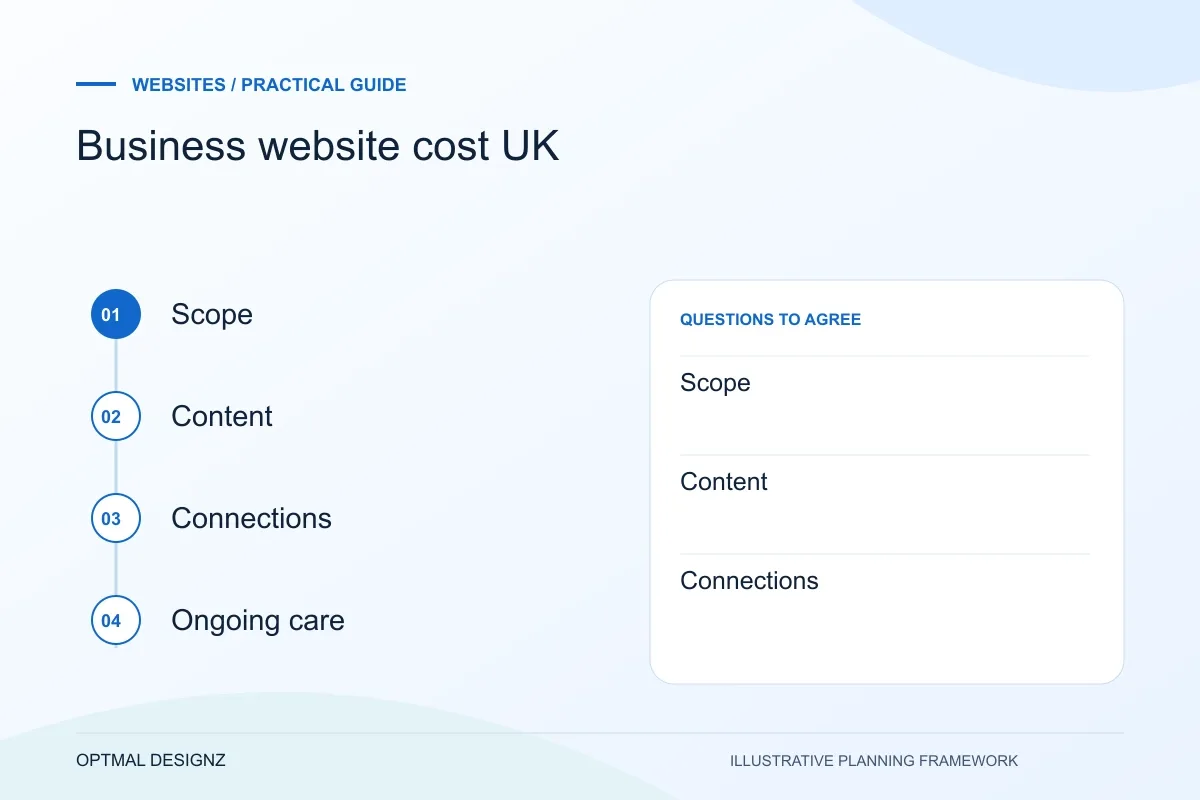
The decision this guide helps you make
A business website’s cost depends on the templates, content, editing, functionality, connections and migration included in scope. Page count helps describe size but does not capture the work behind the visitor journey.
There is no useful single price for every website. A clear estimate follows from scope, content, functionality, risk and the support needed after launch.
Ask for an itemised scope and separate hosting, licences, content production and support. Compare suppliers against the same complete visitor tasks and acceptance conditions.
A practical example to test the choice
Two sites may each have ten pages. One uses supplied copy and standard forms; the other needs a CMS, booking connection, bilingual content and migration. Their effort is not equivalent.
This is an illustrative planning scenario, not a claim about a completed client project. Use your own records and operating rules to confirm whether the approach fits.
Why website quotes can differ
Two websites with a similar number of pages can involve very different work. One may use a standard content structure and a small set of forms; another may need complex product data, account areas, booking rules, accessibility requirements or connections to existing software. Page count alone is a poor way to compare proposals.
A useful estimate explains what is included, what assumptions were made and which decisions could change the work. It should separate discovery, design, development, content, testing, launch and ongoing care so you can see where the effort sits.
The main cost drivers
Scope begins with the jobs the website needs to perform. A simple information site, a catalogue with advanced filtering and a transactional ecommerce site have different data, interaction and testing needs. Custom design can also require more planning than adapting an established component system, especially where different audiences need distinct journeys.
Content is another major input. If the business supplies reviewed copy, product information and usable photography, the project can focus on structure and implementation. If research, writing, migration, image preparation or product data cleanup is needed, those tasks should be named rather than hidden inside a vague development line.
- Number and complexity of page types
- Custom functions, forms, booking or ecommerce flows
- Connections to CRM, accounting, stock or other systems
- Content creation, migration and data quality
- Accessibility, security, performance and testing needs
- Hosting, maintenance and support arrangements
Compare proposals on the same assumptions
Give each supplier the same brief and ask them to list deliverables, exclusions, dependencies, ownership and acceptance criteria. Check who is responsible for content, domain access, third-party accounts, redirects and launch decisions. If an estimate depends on a discovery phase, ask what that phase will produce and how it will narrow the scope.
Be cautious with a quote that gives a precise total before the supplier understands the required journeys, systems and content. An early range can help with budgeting, but it should be labelled as an estimate and updated when assumptions are confirmed.
Budget for the website after launch
A website is an operating asset. Set aside a plan for hosting, software licences, backups, security updates, content changes and technical support. The right arrangement depends on the platform and who will maintain it; a low initial price can become expensive if routine changes require specialist intervention or if nobody owns updates.
The best starting budget is tied to a defined outcome and a realistic first release. Prioritise the pages and functions needed now, make later phases visible, and keep contingency for unknowns that can only be resolved once the current site and systems have been examined.
Turn the budget discussion into a comparable brief
For an information website, describe the main audiences, the page types, who supplies the copy and how visitors will enquire. If a booking or ecommerce journey is needed, describe what happens after submission or payment as well as what appears on the screen. This separates a simple form from a workflow that needs accounts, scheduling, order handling or third-party access.
Ask each supplier to price against the same release and list optional items separately. Keep one-off delivery costs apart from hosting, licences, maintenance and future changes. Do not treat an illustrative price from another business as a quote for your own requirements.
- Link to the current website and list the pages or journeys to retain.
- Name the person responsible for copy, images and review decisions.
- List every form destination, booking flow and external system.
- Agree how launch checks, redirects and handover will be accepted.
Questions that make two quotes comparable
Check whether both proposals include content preparation, migration, enquiry delivery, editing access, testing and handover. List recurring charges and dependencies separately. If one quote assumes ready-to-publish content and another includes writing, they do not describe the same work. Ask for a revised common scope before interpreting the lower headline figure as better value.
Apply the checklist to your UK project
Use a UK visitor’s complete enquiry or purchase as the acceptance task. Confirm who prepares the content, which existing URLs carry useful search visibility and how staff receive the result.
Use the example above to discuss business website cost uk with the people who will use or approve the result. Ask a supplier to demonstrate the expected output, explain a failure case and identify what is excluded from the proposal.
Related services and next steps
Sources and further reading
Check source guidance directly, especially where platform details or requirements can change.