
The decision this guide helps you make
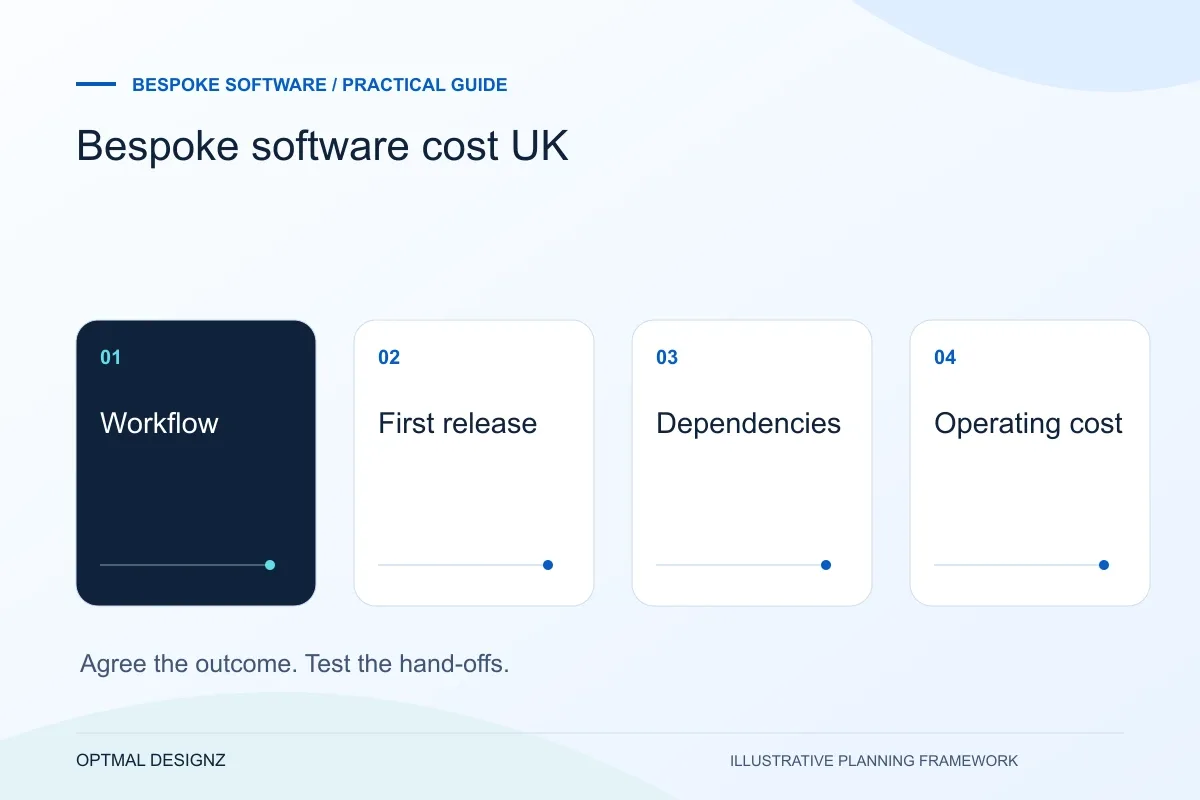
A bespoke software estimate prices the agreed workflows, users, interfaces and delivery responsibilities. It becomes more meaningful when the team can demonstrate what the first release must do and what remains outside it.
Bespoke software is scoped around a particular workflow, so the budget depends on what the system must do and the conditions it must work within.
Define a representative task, roles, integrations and exceptions, then compare a focused first release with later modules. Separate implementation from ongoing operating costs.
A practical example to test the choice
A request-and-approval application differs materially from the same application with two-way accounting integration, complex migration and a customer portal. List those dependencies rather than hiding them in a feature name.
This is an illustrative planning scenario, not a claim about a completed client project. Use your own records and operating rules to confirm whether the approach fits.
Start with the operational problem
A cost discussion is more productive when it begins with the work to improve rather than a feature list. Describe who uses the process, what information moves through it, where delays or errors occur and what a better outcome would look like. Then ask whether configuration, integration or a tailored application is the smallest suitable change.
This matters because bespoke development carries lifecycle responsibilities: requirements, design, build, testing, hosting or deployment, documentation, maintenance and future change. A comparison that looks only at build cost can overlook the people and systems needed to operate the result.
What changes the effort
The largest variables are usually workflow complexity, user roles, exceptions, data migration, reporting, external integrations and the level of assurance required. A single-user internal tool with a small data set has different needs from a multi-branch application that handles sensitive records, concurrent transactions and complex permissions.
Integrations need particular care. A connection is not just moving fields between two screens: teams must agree which system owns each record, how updates are matched, what happens when a service is unavailable and how errors are noticed and corrected. These decisions affect design, implementation and ongoing support.
- Core workflows and exceptions
- Number and type of users, roles and permissions
- Existing systems, APIs and supplier constraints
- Data migration, validation and reporting
- Security, privacy and operational requirements
- Testing, deployment, training and support
Reduce uncertainty before committing
A short discovery phase can turn assumptions into a prioritised scope. Useful outputs include process maps, agreed user journeys, data and integration questions, acceptance criteria, risks and a release plan. It should also identify what can be delivered with existing products, configuration or a smaller first version.
Ask suppliers to state what their estimate assumes, what is excluded and which decisions are still open. Request a breakdown by phase or outcome rather than an unexplained total. A range is often more honest while requirements remain uncertain; it should become more specific as the unknowns are resolved.
Plan for ownership beyond delivery
Before development starts, agree who owns the code, cloud accounts, domain names, third-party licences, documentation and operational monitoring. Clarify support response expectations, maintenance responsibilities and how changes are estimated. The exact commercial terms belong in the project agreement, not in a verbal assumption.
A well-sized project has a clear first outcome and a route to extend it if the need is proven. That keeps investment connected to business priorities and gives the team a chance to learn from real use before committing to a broader system.
Separate the build estimate from the operating model
Request a list of one-off and recurring responsibilities, including migration, hosting, supplier licences, monitoring and maintenance. Add the internal time needed for decisions and acceptance. Compare alternative scopes using explicit assumptions about users and workload. Review those assumptions after the first release instead of presenting the original estimate as a permanent operating budget.
Apply the checklist to your UK project
Use one actual UK team workflow, including the staff who approve changes and the systems they can access. Distinguish implementation from hosting, licences and ongoing support.
Use the example above to discuss bespoke software cost uk with the people who will use or approve the result. Ask a supplier to demonstrate the expected output, explain a failure case and identify what is excluded from the proposal.
Related services and next steps
Sources and further reading
Check source guidance directly, especially where platform details or requirements can change.