
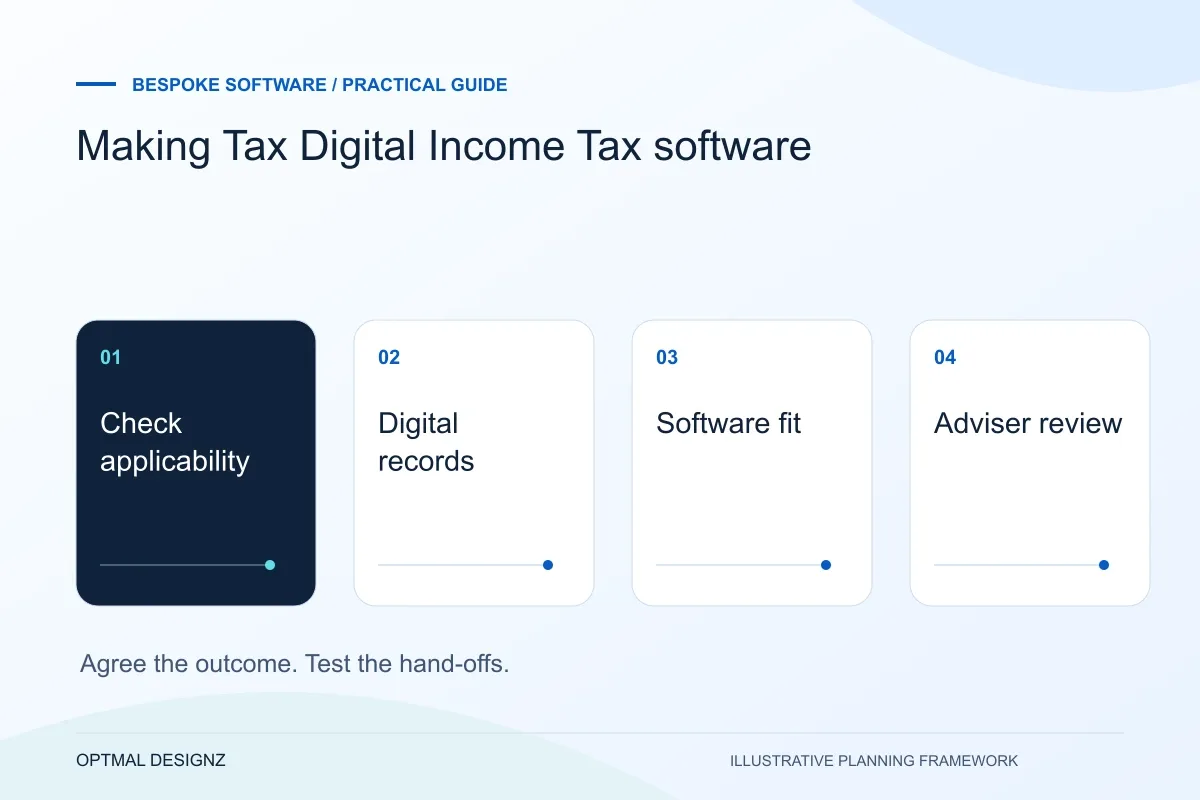
The decision this guide helps you make
UAE e-invoicing planning separates your business’s document workflow from the current official requirements and provider interfaces. Confirm applicability with qualified finance reviewers before choosing what to configure or integrate.
Understand the software work behind an e-invoicing connection, then confirm the obligations that apply to your business with your accountant and current official guidance.
Use current official guidance, approved sample documents and supported provider documentation. Specify validation, corrections, rejected transmissions and reconciliation; do not treat a generic connection as regulatory approval.
A practical example to test the choice
An operations system may prepare a draft invoice while an approved finance application remains responsible for issuing it and handling the required transmission. Define that boundary explicitly.
This is an illustrative planning scenario, not a claim about a completed client project. Use your own records and operating rules to confirm whether the approach fits.
Establish the requirement before choosing software
The UAE Federal Tax Authority identifies the Ministry of Finance portal as the official source for the introduction of e-invoicing. Start there with your accountant to establish the applicable scope, provider requirements and current guidance for your organisation. This guide concerns software planning; it does not determine your tax position or reproduce implementation deadlines.
List the legal entities, branches, transaction types and systems involved. An organisation may create invoices in an ERP, POS, ecommerce platform or separate billing application. Record where the authoritative invoice data lives and who is responsible for checking it.
Separate invoice creation from the provider connection
The Ministry of Finance maintains information on accredited service providers. Verify the proposed provider through that official information and establish what its interface supports. Do not assume that an ordinary accounting application or custom developer is an accredited provider.
Ask how invoice data moves from the originating application to the chosen provider, how validation responses return and who can act on a rejection. A PDF sent by email should not be used as proof that a structured e-invoicing workflow has been implemented.
Map records with the finance owner
Use current official specifications and the chosen provider’s documented interface to agree field mappings. Work with approved examples for customer and supplier identifiers, invoice references, line items, currencies, tax treatment and credit notes. Record which person approves each mapping and how later changes are controlled.
Check that the underlying customer and product records are complete enough to support the proposed connection. Missing data needs an owner and a correction process; the integration should not silently invent required values.
- Inventory invoice-producing systems and record owners.
- Confirm the selected provider against official accreditation information.
- Use finance-approved examples and current interface specifications.
- Define validation, correction and resubmission responsibilities.
Prove recovery as well as successful transfer
Test accepted records alongside rejected values, duplicate submissions, delayed responses and temporary provider unavailability. Establish a stable correlation reference so staff can connect an originating invoice to the provider status without creating a second invoice during a retry.
Agree whether the business may continue a particular operation when a response is delayed, what staff see and when a supervisor must intervene. These decisions need finance and operational approval; they should not be guessed by the software team.
Prepare the operational handover
Document monitoring, authorised access, credential management, data retention responsibilities and the support boundary between your business, software supplier and provider. Confirm who reviews unresolved exceptions and reconciles the originating records with transfer status.
Optimal Designz can discuss software data flows and integration scope. We do not claim UAE e-invoicing accreditation. Keep compliance decisions and the verification of provider eligibility with the relevant qualified advisers and official sources.
Apply the checklist to your UAE project
For a UAE software brief, distinguish company-wide records from branch or legal-entity records. Define who can approve a request across locations, which regional platform editions are used and what English/Arabic tasks require testing.
Use the example above to discuss uae e-invoicing software with the people who will use or approve the result. Ask a supplier to demonstrate the expected output, explain a failure case and identify what is excluded from the proposal.
Related services and next steps
Sources and further reading
Check source guidance directly, especially where platform details or requirements can change.