
The decision this guide helps you make
A service page should explain what the service is, what it can do, who it suits, what a project can deliver and how to take the next step. Put those answers before a long description of the supplier’s development process.
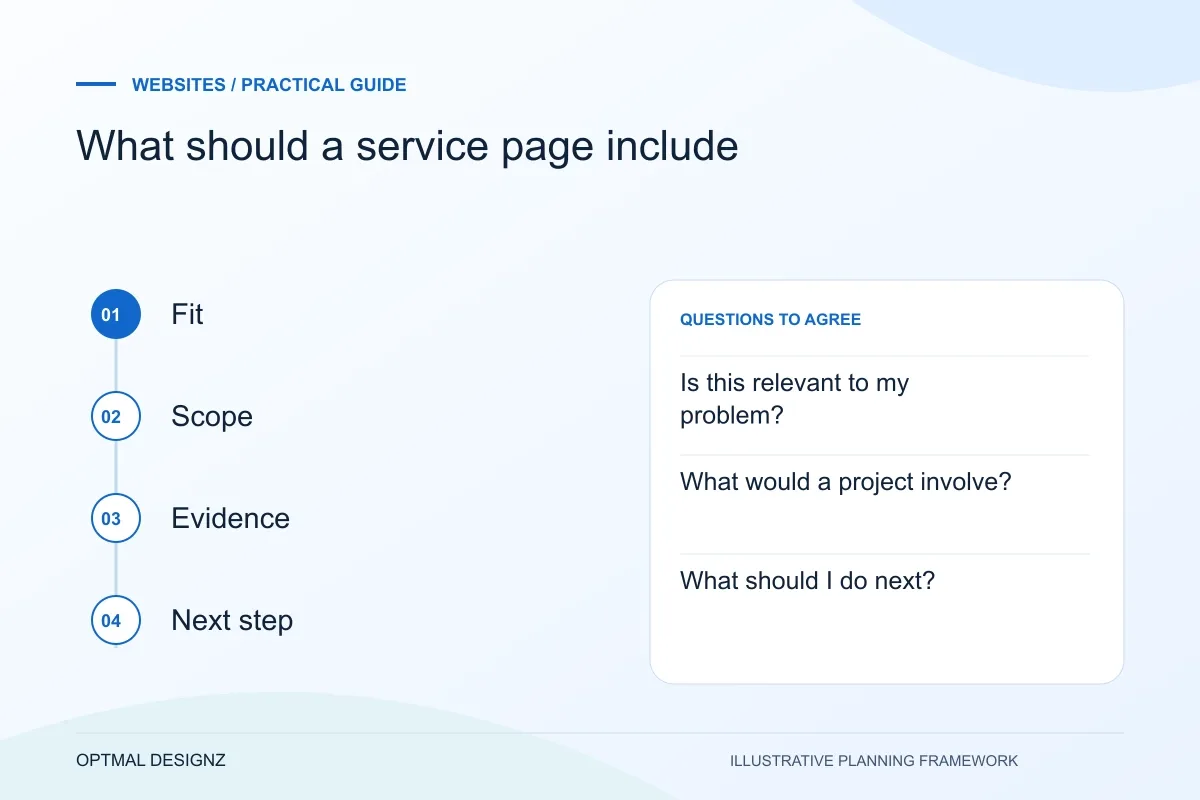
Structure service pages around buyer fit, scope, evidence, practical questions and a relevant next step without repetitive keyword-heavy copy.
Give concrete capabilities and a representative scenario, distinguish included scope from optional features, and show when an existing product may be sufficient.
A practical example to test the choice
A POS page should describe sales, returns, stock and supported payment connections before explaining discovery workshops. A buyer needs to recognise their task before assessing how it will be delivered.
This is an illustrative planning scenario, not a claim about a completed client project. Use your own records and operating rules to confirm whether the approach fits.
Answer the decision behind the visit
A service page should help someone decide whether the offer relates to their problem. Explain the work in plain language, who it suits and which situations may call for another approach. Visitors should not need to decode an abstract slogan before discovering what the business actually provides.
Keep the page distinct from an educational article. A guide can explore a topic broadly; the service page needs to explain the specific route to working with the company. Link to deeper guidance where it helps a buyer rather than repeating a full general-interest article inside the sales page.
Turn the guide into an Oman website brief
For an Oman business, start with the audience and the action the website needs to support. A service enquiry, trade catalogue and consumer checkout need different page structures and information. Use genuine service coverage for Muscat, Sohar, Salalah and other relevant locations instead of creating interchangeable city pages.
If the audience needs English and Arabic, assign content ownership for both languages. Agree right-to-left layouts, paired pages, form messages and how changes will be maintained. Where online sales are involved, confirm OMR formatting, delivery coverage and the capabilities of the actual merchant and logistics accounts.
Make scope and evidence concrete
Describe the types of deliverables or workflows that might be included and the decisions needed to agree a project. Use relevant diagrams or examples to explain the work. If an example is hypothetical or an image is illustrative, label it so readers do not mistake it for a delivered client project.
Publish client names, results and testimonials only when they are genuine and approved. A missing case study is a reason to explain the approach clearly, not to manufacture a success story. State the information a buyer should share and what still needs investigation before a quote.
Use clear headings and a useful next action
Google’s title-link guidance supports descriptive, accurate titles and discusses the signals used to create search-result titles. Align the title, main heading and visible offer, while recognising that Google may present a different title. Repeating a phrase in every heading does not make the page more useful.
Place a relevant enquiry action after the visitor has enough context to act, and make the label describe that next step. Include the questions buyers genuinely need answered: suitability, dependencies, handover and what affects cost or timing. Use existing service and guide pages to provide meaningful internal links.
Create a buyer-question map
Write the questions a qualified visitor asks before enquiring, then identify the section that answers each one. Mark any answer that depends on evidence the business has not approved for publication. Use that gap to request genuine material or explain the scope clearly rather than inserting an unsupported claim. Compare neighbouring service pages too: if they answer exactly the same questions, clarify their separate purposes before producing more text. The finished map should lead to a page a prospect can assess without speaking to a salesperson first.
| Buyer question | Useful page content |
|---|---|
| Is this relevant to my problem? | Specific situations and service boundaries |
| What would a project involve? | Deliverables, dependencies and acceptance |
| What should I do next? | Relevant enquiry instructions and guide links |
Worked example: a planning exercise
Hypothetical example: a software company has separate pages for custom software and integration. Both initially repeat the same development process. The revised integration page explains record ownership, interface access and failed-transfer handling, while the custom page focuses on workflow fit and a first release. Each now supports a different buying decision.
Your practical checklist
Use these checks to turn the discussion into decisions that can be assigned, tested and reviewed.
- Describe the problem, intended buyer and service boundary.
- Use specific workflow or deliverable examples.
- Label hypothetical examples and illustrative media honestly.
- Use genuine evidence only where publication is approved.
- Align descriptive titles, headings and visible content.
- Provide relevant reading and a clearly labelled enquiry route.
Apply the checklist to your Oman project
For an Oman brief, make service coverage and delivery or appointment conditions clear for Muscat and other relevant locations. Where commerce is included, test OMR price presentation, required language journeys and the confirmation received by the customer.
Use the example above to discuss what should a service page include with the people who will use or approve the result. Ask a supplier to demonstrate the expected output, explain a failure case and identify what is excluded from the proposal.
Related services and next steps
Sources and further reading
Check source guidance directly, especially where platform details or requirements can change.