
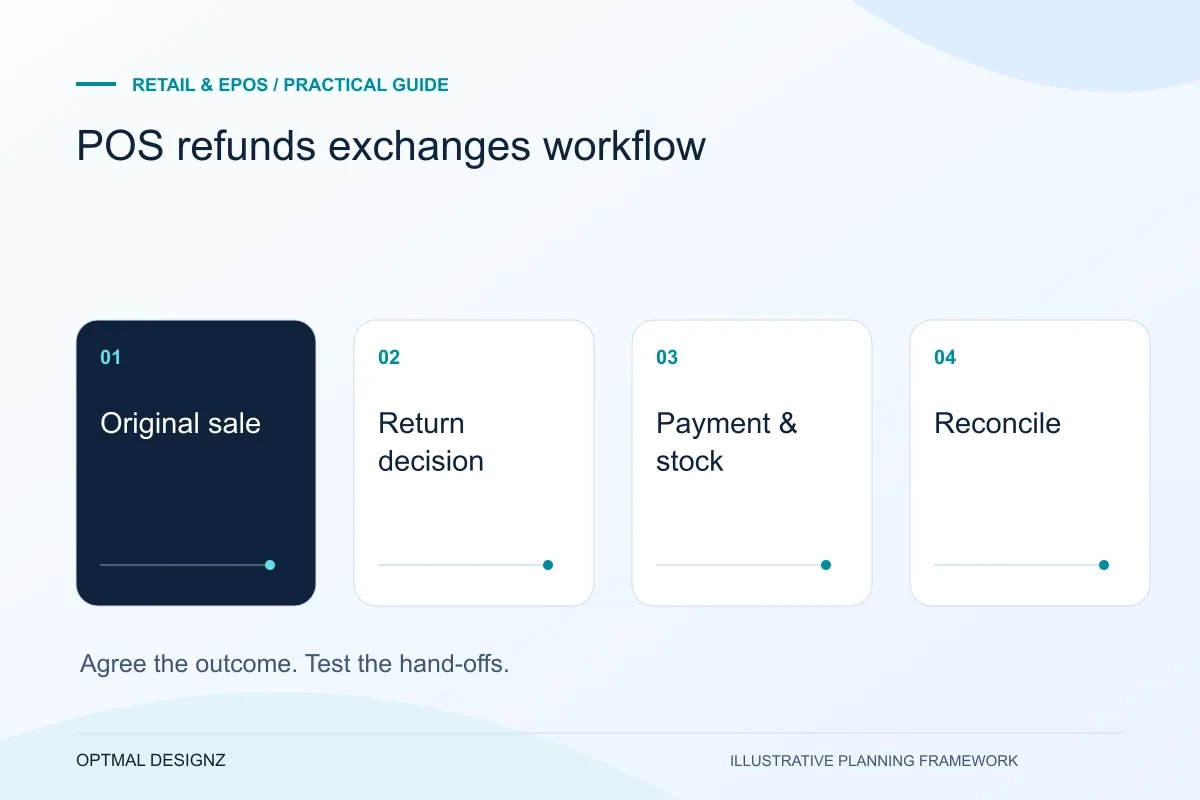
The decision this guide helps you make
A POS refund or exchange links a correction to the original sale, the payment action and the stock outcome. These events need clear permissions and separate status confirmation.
Test returns across payment, stock, permissions and receipts, including partial refunds and exchanges that change the order value.
Define original-sale matching, authorised overrides, provider refund confirmation and stock disposition. Test partial returns, exchanges and failed payment responses.
A practical example to test the choice
A returned item may be damaged and unavailable for resale even when the refund succeeds. Automatically increasing available stock would misrepresent what can be sold.
This is an illustrative planning scenario, not a claim about a completed client project. Use your own records and operating rules to confirm whether the approach fits.
Separate the customer decision from the system actions
The business needs an approved returns policy and appropriate advice where required. The software task is to implement the agreed workflow consistently: locate the sale, identify eligible items, confirm permission and record the chosen return, refund or exchange. A development team should not invent policy from a till screen.
List whether staff need to handle receipts, multiple branches, original payment methods or online orders returned in store. Include partial quantities and products that cannot go back into sellable stock. Each can affect the payment result and inventory in a different way.
Check the actual Oman store and payment setup
Inventory the till software, device models, printers, scanners and merchant account used by the Oman business. Separate a recorded sale from payment authorisation, settlement and finance reconciliation. A provider demonstration for another region does not establish availability or supported behaviour for the selected account.
For more than one location, agree stock ownership, transfers and permissions before combining reports. Use representative sales, returns and corrections to test OMR display and finance-approved receipt details. Offline behaviour must be established and tested for the actual devices, architecture and payment provider.
Test the linked payment and stock outcomes
An exchange can involve returning an item, selling another and collecting or returning a difference. Verify what the actual platform supports, including provider restrictions. Shopify documents its exchange and store-credit flows; those capabilities should be checked against the intended account and current product conditions.
Confirm what happens if a payment refund fails after a return is recorded. Staff need a visible state and an approved resolution route rather than attempting the entire action again without knowing what completed. Keep stock disposition and payment status clear enough for the operator and finance reviewer.
Include permissions and reconciliation
Agree who can authorise refunds, overrides and store-credit actions, with records sufficient to investigate an issue. Test both an authorised and an unauthorised staff role. A hidden button is not adequate evidence that a sensitive action is protected.
Reconcile representative refunds and exchanges through the receipt, stock movement and reporting totals. Include discounts and part-payments where relevant to the actual business. Record unresolved exceptions as acceptance issues before live rollout, because a straightforward sale demonstration rarely exercises these boundaries.
Ask for an approved transaction test pack
Have the business and finance owners agree examples for the return types staff actually handle. Include the original sale, item condition, permitted refund route and expected stock and reporting result. Record the supported provider behaviour and the result if one part fails. Use the same pack for configuration, integrations and staff training rather than allowing each team to invent its own interpretation. Revisit it when the returns policy, payment provider or platform changes.
| Scenario | Expected result to approve |
|---|---|
| Partial return | Remaining order and correct stock disposition |
| Different-value exchange | Difference collected or returned through a supported route |
| Payment failure | Visible state and authorised resolution process |
Worked example: a planning exercise
Hypothetical example: a customer returns one discounted item and exchanges it for a higher-priced variant. The pilot checks the remaining order, the difference to collect and whether the returned item is sellable. Staff and the finance owner approve the expected result before this transaction becomes part of the live till workflow.
Your practical checklist
Use these checks to turn the discussion into decisions that can be assigned, tested and reviewed.
- Start from the business’s approved returns policy.
- List cross-branch, online, partial and discounted scenarios.
- Separate payment status from returned-stock condition.
- Check provider-supported refund and exchange behaviour.
- Test permissions, failure recovery and repeated attempts.
- Reconcile receipts, stock and reports against approved examples.
Apply the checklist to your Oman project
For an Oman trading workflow, test an order at one location fulfilled from another, including a partial receipt or return. Confirm OMR precision, delivery coverage, connectivity assumptions and the supported provider interfaces using the business’s own accounts.
Use the example above to discuss pos refunds exchanges workflow with the people who will use or approve the result. Ask a supplier to demonstrate the expected output, explain a failure case and identify what is excluded from the proposal.
Related services and next steps
Sources and further reading
Check source guidance directly, especially where platform details or requirements can change.